A platform can be stable yet make every strategic change slow and expensive.
Executive insight · Architecture
Make commerce architecture a business choice about speed, control, and optionality.
Architecture determines how safely the company can change: launch a market, add a brand, replace a supplier, integrate an acquisition, or recover from disruption. Senior leaders do not need to choose technical components; they do need to decide where the business requires control, reuse, independence, and evidence.
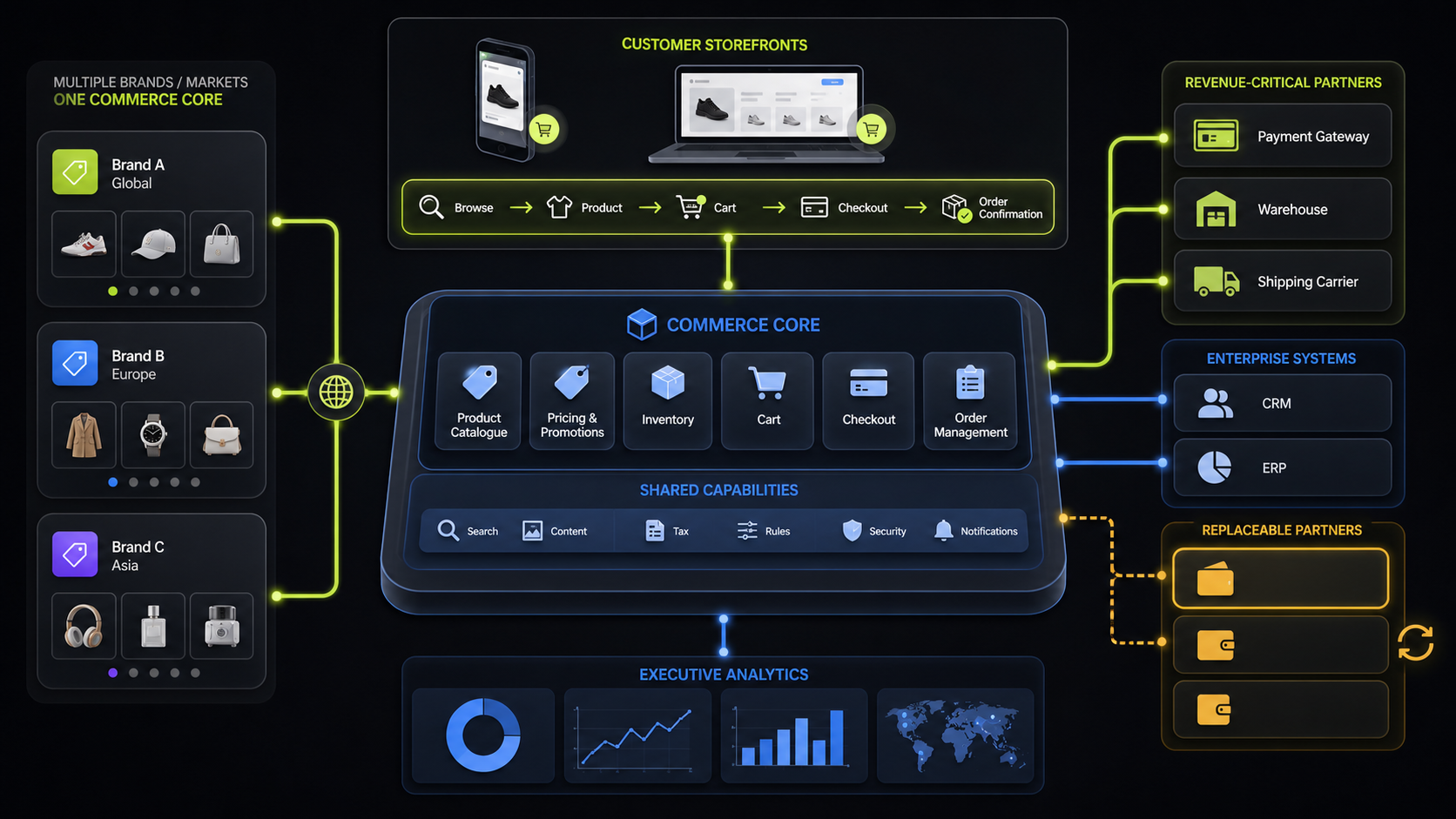
Why this belongs on the executive agenda
Unclear ownership turns ordinary change into cross-company coordination.
Optionality has value when markets, partners, regulation, and customer expectations move.
C-suite pain points
The commercial problem is larger than the functional symptom.
GrowthCEO · CTO
Strategy moves faster than the platform
Market launches, business-model changes, and acquisitions wait because ordinary commercial changes touch too many systems and teams.
Enterprise riskCFO · CTO
The company cannot price dependency
Critical revenue may depend on one platform, supplier, integration, or individual without a tested exit or continuity path.
Capital efficiencyCFO · COO
Change spend produces little reuse
The same catalogue, pricing, checkout, integration, and reporting capabilities are rebuilt for each brand or channel.
Illustrative $50M multi-brand group
The annual cost of architecture that makes every change cross-functional
A portfolio-level investment model. Replace initiative count, team effort, delay, revenue timing, remediation, and supplier concentration with the company’s actual change ledger.
- Change investment$2.8M
- Constraint remediation−$1.1M
- Delay exposure−$2.4M
- Reusable capacity+$1.6M
Executive use: validate the assumptions with Finance, then use the model to agree the accountable owner, investment ceiling, target outcome, and evidence required to release the next stage of funding.
Business impact
Translate the issue into outcomes leadership can govern.
Strategic speed
Shorten the path from commercial decision to a safe customer-facing change.
Investment control
Direct spend toward reusable capability and away from repeated remediation.
Vendor optionality
Replace or add capabilities without rebuilding the entire customer and operating journey.
Continuity and risk
Contain failures and protect critical trading, data, and operational responsibilities.
Leadership decision framework
Move from concern to a governed investment decision.
Which business changes must become easier over the next three years?
Name priority markets, brands, channels, acquisitions, models, and customer promises.
Where does ownership create competitive or risk value?
Separate differentiating capabilities from those best sourced as reliable commodities.
What must change independently without disrupting trade?
Align business ownership, data authority, supplier accountability, and investment boundaries.
How will architecture remain connected to commercial priorities?
Review lead time, reuse, risk, cost, and decision debt—not a technical diagram alone.
Executive scorecard
Measure the commercial condition—not the volume of activity.
MeasureWhat it tells leadershipEarly warning
Change lead timeSpeed from approved decision to reliable outcomeMost time is spent coordinating dependencies
Change concentrationHow many teams and systems ordinary change touchesSmall commercial changes require broad releases
Reuse across growth unitsLeverage gained across brands, markets, and channelsEach launch rebuilds the same foundations
Exit and recovery readinessAbility to contain failure or change a supplierCritical revenue has no practical alternative path
Questions for the next leadership review
Use the meeting to make choices, not simply inspect reporting.
- Which strategic move is hardest because of the current platform?
- Where are we paying repeatedly for the same capability?
- What must the company own—and what should it be free to replace?
- Which architecture risk has a material revenue or regulatory consequence?
Continue the decision
Move from insight to the relevant operating path.
Architecture working session
Turn the executive question into an evidence-led roadmap.
Bring the strategic priority, current performance, constraints, affected teams, and decisions already in motion. We’ll frame the commercial exposure, ownership, measures, and next investable step.